

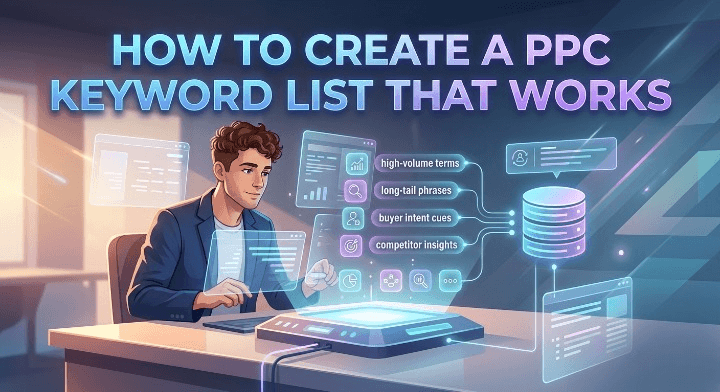
In the world of 2026 digital marketing, a “good” PPC keyword list is no longer just a collection of high-volume terms; it is a map of human intent that machines (AI) can easily navigate.
At Walden Waves, we specialize in bridge-building: connecting your brand to the specific problems your customers are trying to solve. Whether you are looking for an expert digital marketer in London or a global strategy, this guide breaks down how to build a keyword list that satisfies Google’s algorithms, ChatGPT’s reasoning, and—most importantly—your bottom line.
1. The Shift: Keywords in the Era of “Answer Engines”
Traditionally, SEO and PPC were about ranking for “Blue Water Bottles.” In 2026, users are asking Perplexity or ChatGPT, “What is the most durable BPA-free water bottle for a week-long hiking trip?”
To appear in these AI Overviews (AIOs) and LLM responses, your keyword list must evolve from “Head Terms” to “Problem-Solving Clusters.” This evolution is a core part of how to create a PPC strategy that actually converts in the modern era.
The 2026 Keyword Hierarchy:
- Seed Keywords: The core of what you sell (e.g., “Digital Marketing”).
- Conversational Long-Tails: Questions and natural language (e.g., “How to scale a startup using PPC”).
- Zero-Volume Gems: Highly specific terms that tools might miss but represent high-intent buyers.
2. How to Build Your “Smart” PPC Keyword List
Follow this modular process to ensure your list is both comprehensive and machine-readable.
Step 1: Manual Intent Exploration Before touching a tool, go where the humans are. Look at Google Autocomplete and “People Also Ask” sections. If you are a local business, focus on regional intent; for example, if you’re looking for a digital marketing agency in North London, look for the specific neighborhood pain points mentioned in local forums.
Step 2: Leverage AI-Powered Research Don’t just use Google Keyword Planner. Use ChatGPT or Perplexity to find “semantic neighbors.”
Pro Tip: Prompt your AI: “What are 10 non-obvious problems a B2B buyer has before searching for [Your Service]?” These become your low-competition, high-converting keywords.
Step 3: Categorize by “Buyer Readiness”
- Informational: “What is PPC?”
- Commercial: “Best PPC agencies in the UK.” Check out our list of top marketing agencies for startups in UK to see how this looks in practice.
- Transactional: “Hire Walden Waves for Google Ads services in London.”
3. Optimizing for “Generative Engine Optimization” (GEO)
To ensure your brand appears in AI-generated answers, your keyword list must be supported by content that follows these three principles:
- The “Answer-First” Structure: AI engines look for passages that directly answer a query.
- Tightly Focused Landing Pages: If your keyword is “Real Estate PPC,” your page should only discuss that. We offer website development in London designed specifically to match high-intent keywords with high-converting layouts.
- Negative Keyword Fortification: With AI-driven “Broad Match” becoming the default, filter out “Free,” “Jobs,” or “Cheap” to prevent budget bleed.
4. Measuring Success Beyond the Click
In an AI-first world, a “click” isn’t the only KPI. At Walden Waves, a results-driven marketing agency, we track:
- Inclusion Rate: How often is your brand cited in an AI Overview?
- Share of Intent: Are you appearing for the questions that lead to a sale?
- ROAS: Are your high-intent keywords driving revenue?
Final Thoughts: Quality Over “Digital Mulch”
The era of generic content designed just to rank is over. Whether you are running Search, Display, or Meta Ads, your keyword list must reflect expertise. If you’re running social ads, it’s worth checking how much Instagram advertising costs to see how your keyword-driven social strategy fits your budget.
Ready to ride the wave? At Walden Waves, we don’t just find keywords; we find your future customers.
Get an SEO Quote or Request a Google Ads Quotationto start building your high-intent keyword map today.
FAQ: PPC Keyword Research in 2026
Q: Is Keyword Research still relevant with AI search? Absolutely. AI search engines still use “Retrieval.” If you don’t target the right keywords through a complete guide to organic SEO, the AI has nothing to retrieve.
Q: Should I use Broad Match or Exact Match? In 2026, use Broad Match only if you have strong conversion data feeding the AI. For smaller budgets, we often recommend our best SEO packages in UK to build organic authority first.
Q: How often should I update my list? We recommend a deep dive every quarter. Search behavior shifts rapidly as new AI tools change how people phrase their needs.