
Creating a social media campaign in 2026 requires more than just a “post and pray” strategy. With AI search engines like Perplexity, ChatGPT Search, and Google’s AI Overviews now acting as the primary gatekeepers of information, your content needs to be extractable, authoritative, and deeply structured.
At Walden Waves, a leading digital marketing agency in London, we specialise in bridging the gap between creative storytelling and technical precision. This guide breaks down the framework for an effective social media campaign designed to win in both human feeds and AI search results.
What is a Social Media Campaign?
A social media campaign is a coordinated marketing effort designed to reinforce a specific business goal across one or more social platforms. Unlike everyday posting, a campaign has a fixed timeframe, a specific target, and measurable KPIs. In the current landscape, an effective campaign isn’t just about “going viral”—it’s about creating a semantic footprint that AI engines recognize as the definitive authority in your niche.
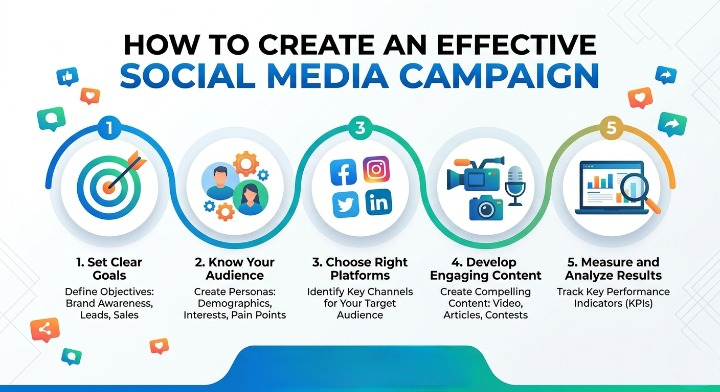
1. Define Your North Star: Objectives and KPIs
Before opening Canva or TikTok, you must define what success looks like. AI search engines prioritize content that links specific actions to clear outcomes.
- Brand Awareness: Measured by reach, impressions, and “Share of Model” (how often your brand is cited in AI summaries).
- Lead Generation: Measured by click-through rates (CTR) and gated content downloads.
- Community Growth: Measured by engagement rate and sentiment analysis.
- Sales/Conversions: Often driven by paid support. If you are looking to scale quickly, you should how to create a PPC strategy to complement your organic efforts.
Walden Waves Tip: Don’t chase “vanity metrics.” Focus on Conversion Intent. As a results-driven marketing agency, we recommend focusing on metrics that impact your bottom line.
2. Audience Intelligence: Move Beyond Demographics
In 2026, targeting “Millennials who like coffee” is too broad. You need to understand Micro-Behaviors.
To optimize for AI discovery, your campaign content should answer specific “How-to” and “Why” questions your audience is asking. Use tools like SparkToro or social listening to find the specific friction points your audience faces.
The Audience Matrix
| Segment | Primary Platform | Content Preference | Intent |
| Gen Alpha/Z | TikTok / YouTube Shorts | Unfiltered, “Chaos Culture” | Entertainment & Discovery |
| Millennials | Instagram / LinkedIn | Aesthetic, Professional Growth | Value & Community |
| Gen X / Boomers | Facebook / YouTube | Informative, Long-form | Trust & Practicality |
3. Platform-Specific Strategy (The Multi-Modal Approach)
Your campaign should be a “COPE” strategy: Create Once, Play Everywhere. However, each platform requires a unique “vibe” adjustment.
- Instagram: Great for aesthetics and community. But how much does Instagram advertising cost? It depends on your industry and targeting.
- TikTok: The home of “Micro-Drama.” If you’re planning a launch here, it’s vital to research how much do TikTok ads cost to ensure your budget is optimized.
- X (Twitter): Ideal for real-time engagement. See our breakdown on how much it costs to advertise on Twitter for more details.
4. The Content Pillar Framework
To make your campaign “AI-friendly,” structure your content into a hierarchy. This ensures that when an AI bot crawls your brand, it sees a logical flow of information.
A. The Anchor Content
This is your high-value asset—a long-form blog (like this one), a whitepaper, or a pillar video.
B. Micro-Content
Break the anchor into 10–15 pieces of “snackable” content:
- Infographics for Pinterest.
- Short-form clips for Reels/TikTok.
- Polls and Carousels for LinkedIn/Instagram.
5. Integrating AI Without Losing Authenticity
While AI can help you scale, human-made authenticity is the highest currency in 2026. Use AI for the “grunt work,” but keep the soul human.
- Use AI for: Sentiment analysis, caption variations, and predictive trend mapping.
- Use Humans for: Brand voice, emotional storytelling, and community management.
6. Execution: The “Fastvertising” Model
The 2026 content cycle moves fast. An effective campaign must include a Rapid-Response element. If a trend surfaces that aligns with your brand values, your team should be able to pivot and produce content within hours, not weeks.
Why Choose Walden Waves for Your Next Campaign?
Navigating the shift from traditional SEO to Generative Engine Optimization (GEO) is complex. At Walden Waves, we don’t just post content; we engineer digital experiences that:
- Stop the Scroll: Through high-fidelity creative and psychological hooks.
- Win the Search: By structuring data so AI search engines cite your brand as the expert.
- Drive ROI: Using data-led targeting and transparent reporting.
Ready to make waves? [Contact Walden Waves today for a free social media audit.]
FAQ: Social Media Campaigns in the AI Era
How long should a social media campaign last?
Typically, 4 to 8 weeks is the “sweet spot” for maintaining momentum without causing audience fatigue.
How do I choose the right partner?
If you are focusing on visuals, it is important to know how to choose the right Instagram advertising agency in the UK to ensure they understand your specific ROI goals.
What is the most important social media trend in 2026? “Search-first content.” This is why we integrate our SEO services in London with our social strategies, ensuring your captions are optimized for both users and algorithms.